


“The hardest thing in the world to understand is the income tax.” ” -Albert Einstein
Tax Strategies for High-Income Tech Sales Professionals
High-income enterprise technology sales professionals face a tax problem most earners do not encounter: a compensation structure built almost entirely from W-2 salary, commissions, bonuses, and vested RSUs — the four income types the IRS taxes most aggressively, with the fewest legal ways to reduce what is owed. Earning $400,000, $700,000, or more no longer guarantees keeping more of it; without a deliberate tax strategy, the opposite is often true.
This article explains why high-income tech sales compensation is taxed so heavily, walks through the specific IRS mechanism that allows real estate depreciation to offset that liability, and shows how one investor used it, including the household requirement that made it possible, which is often left out of this conversation.
The Structural Problem with W-2 Income
- Commissions and Bonuses: They receive no deferral option and are taxed at the highest marginal bracket the moment they are paid.
- RSUs: Taxed as ordinary income at vesting rather than at sale, based on fair market value the day shares vest; if the stock declines afterward, the tax liability does not adjust downward.
- Employer Withholding: Frequently under-collects relative to what is actually owed on RSUs and bonuses, creating an unplanned tax bill at filing time.
- Standard Deductions: Small relative to income at this level.
Here is what that looks like in dollars for a representative technology sales professional earning $650,000 in total compensation: $350,000 in base salary, $200,000 in vested RSUs, and $100,000 in commissions and bonus.
- Federal Income Tax: 37%, taxed as ordinary income.
- Federal Supplemental Withholding: 22%, on commissions and bonuses under $1M.
- RSU Withholding: 22%, of fair market value at vest.
- California State Income Tax: 13.3%, top marginal rate.
- California Supplemental Withholding: 10.23%, on bonuses and RSUs.
- California Commission Withholding: 6.6%.
- Medicare and Social Security: Layered on top of all of the above.
Combined, 40 to 45% of total compensation is typically lost to taxes before it reaches a bank account. For the $650,000 earner above, that is $260,000 to $292,500 gone every single year, more than most households earn in total, disappearing before it is ever touched. High W-2 earners carry this exposure with almost no legal mechanism to reduce it, unless they change where their capital is allocated.
That 40 to 45% does not stop at filing. Because W-2 income has no deferral, the same bite comes out of every paycheck all year, a steady, recurring loss known as tax drag. Real estate is one of the few asset classes the tax code treats differently, though the benefit applies only under specific conditions worth understanding before assuming it applies broadly.
How Real Estate Depreciation Offsets Income
Passive investment in private real estate provides access to a tax mechanism the IRS built specifically to incentivize investment in housing: depreciation, a non-cash deduction that offsets passive rental income received from the investment itself. It is common for investors to receive depreciation equal to 40 to 50% of their investment, which means the passive monthly or quarterly income they receive is sheltered from taxes and does not increase their taxable income.
This benefit is available only through direct or passive ownership in private real estate, not through REITs, mutual funds, or ETFs, which do not pass depreciation through to individual investors.
When Depreciation Can Also Offset W-2 Income
By default, depreciation can only offset passive income, not W-2 salary, commissions, or bonuses. REPS (Real Estate Professional Status) is the force multiplier that breaks that wall, and most high earners already qualify without realizing it. If the couple owns an active investment such as a single-family rental, and meets a few other minimal time requirements, files jointly, a non-working spouse can often qualify for REPS. This isn’t a rare loophole: doctors, lawyers, and other high-income professionals commonly use REPS through a non-working spouse who manages an active rental property, saving hundreds of thousands in taxes each year. Confirm eligibility with a CPA.
Case Study: Anthony’s Result
Anthony, a Regional Director of Sales at an enterprise SaaS company, earned $400,000 in W-2 compensation last year. He reallocated $100,000 of vested RSUs into private real estate, reducing his concentration in company stock. The investment yielded 5% in passive income that year, or $5,000, and generated $50,000 in depreciation, roughly 50% of his investment.
Anthony's Year-One Income
|
Base Salary
|
Commissions
|
RSUs Vested
|
Passive Income from the Property
|
Total Year-One Income
|
|---|---|---|---|---|
|
$200,000
|
$100,000
|
$100,000
|
+$5,000
|
$405,000
|
He used all $50,000 of that depreciation in year one:
How the $50,000 in Depreciation Was Applied
|
Shelters Passive Income
|
Applied Against Bonus & RSU Shortfall
|
Total Depreciation
|
|---|---|---|
|
$5,000
|
$45,000
|
$50,000
|
Nearly $200,000 was withheld from his earnings over the course of the year. His bonus and RSU withholding still fell short, leaving him on track to owe money at filing. Because he qualified under REPS, the depreciation from his investment could be applied against that shortfall, turning what he owed into a refund.
Anthony's Tax Bill, Before and After
|
Tax Shortfall Before Depreciation
|
Depreciation Applied
|
Net Refund
|
|---|---|---|
|
$(10,000)
|
$45,000
|
$35,000
|
The result was threefold for Anthony: passive income his RSUs were never generating on their own, a $35,000 refund that covered his daughter’s tuition, and his original $100,000 still generating income for him at the property.
Compounding It Further: The 1031 Exchange
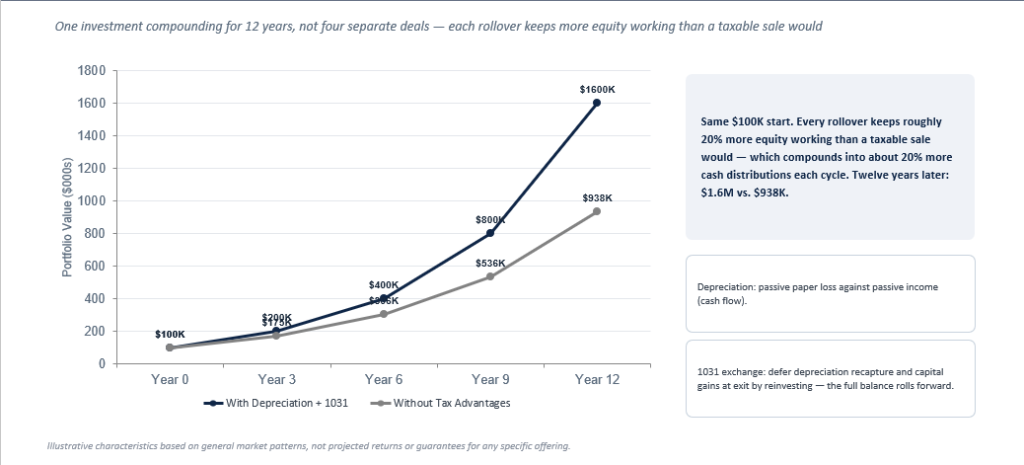
Depreciation is not the only tool. When an investor sells and rolls the proceeds into a new property through a 1031 Exchange, both the capital gains tax and the depreciation recapture are deferred indefinitely, compounding equity instead of paying it out in taxes at every transaction. Each rollover keeps roughly 20% more equity working than a taxable sale would, compounding faster with every cycle:
This Is Tax Policy, Not a Loophole
Passive real estate gives high-income earners three things public markets don’t:
- Income that doesn’t push you into a higher bracket.
- Wealth that compounds through depreciation and the 1031 Exchange.
- For many, a way to offset W-2 income itself.
Reallocating vested RSUs into real estate is a common strategy among top earners, not a fringe move, and these are incentives written into the tax code, available only through direct or passive ownership in private real estate, not mutual funds, REITs, or publicly traded vehicles.
Next Steps
Passive real estate ownership can create income without increasing your tax bracket, compound wealth through depreciation and the 1031 Exchange, and in many cases offset W-2 income directly. Schedule a call to see which of these applies to your situation.